
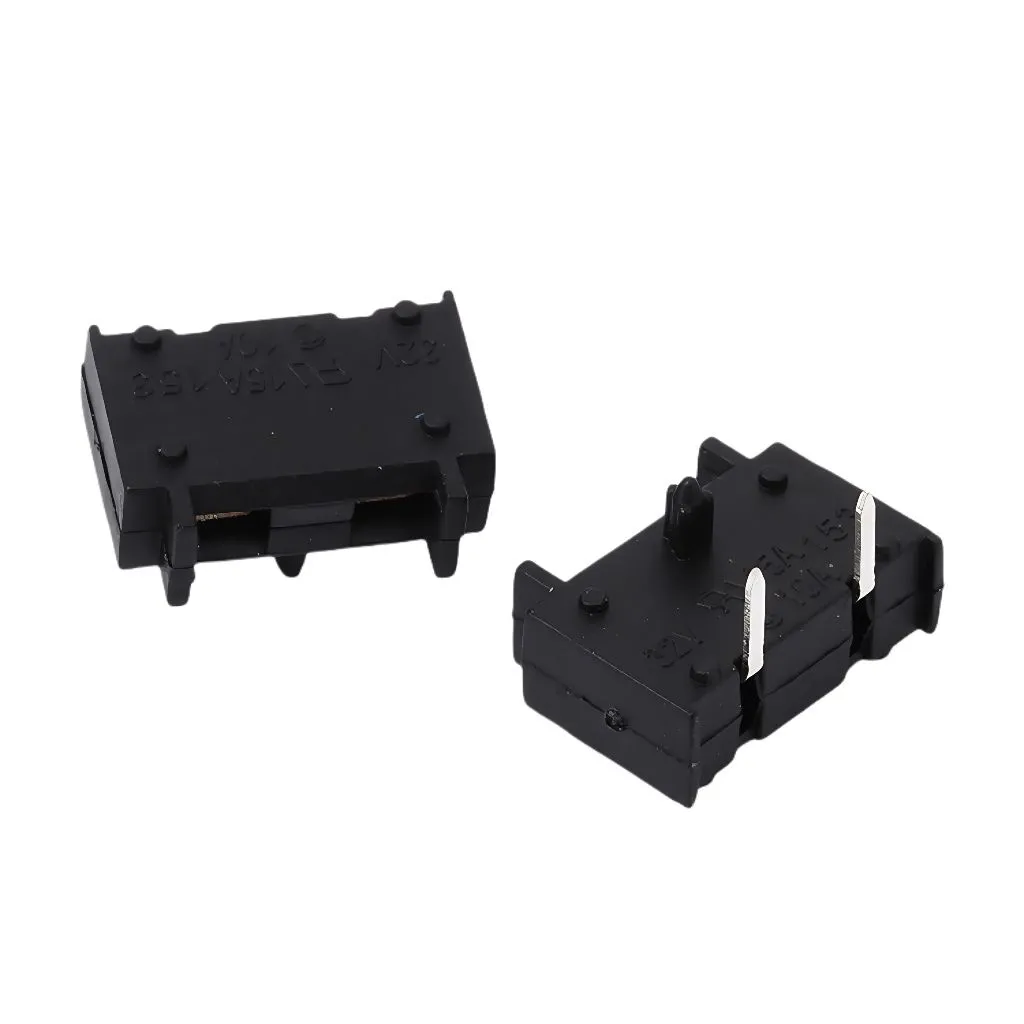
It looks impossible. The protective device is the part designed to sacrifice itself, yet in a melted holder the device sits there intact while the plastic around it has deformed. If the current was high enough to destroy the holder, why was it not high enough to open the device? The answer is that the holder was not destroyed by excess current. It was destroyed by heat generated locally, at the contact between the holder terminal and the device blade. Understanding that distinction is the whole subject.
The Heat Was Never in the Device
A protective device opens when its element reaches a defined temperature. That element is calibrated, and it responds to the current passing through it. The holder terminal is different. It is a mechanical spring contact that grips the blade. Its temperature depends not on the circuit current but on the resistance of that contact multiplied by the square of the current. A well-made contact has very low resistance and stays cool. A contact that is loose, corroded, or has lost its spring tension has higher resistance, and it generates heat in proportion to the square of the current flowing through it. Crucially, that heat is generated at the contact — inside the holder body — and it has nowhere to go. So the holder can be running at 150 °C while the element itself is nowhere near its melting point. The device is doing exactly what it should. The plastic around it is simply being cooked from outside.
How the Feedback Loop Runs
This failure is progressive, and it runs like this: 1. Contact resistance rises, from looseness, corrosion, or loss of terminal tension 2. Heat at the contact increases in proportion to current squared times resistance 3. Elevated temperature accelerates oxidation of the contact surfaces 4. Oxide has higher resistance than clean metal, so resistance rises further 5. Higher resistance means more heat, and the cycle accelerates 6. Meanwhile each thermal cycle anneals the spring metal, reducing terminal tension further 7. Eventually the plastic softens, the terminal loses grip completely, and the holder deforms The loop is self-reinforcing, which is why the failure always seems sudden. It was not sudden. It had been running for months, getting slightly worse on every drive.
Terminal Tension Is the Hidden Variable
Of all the factors involved, terminal tension is the one nobody measures. A blade holder works by spring force. The terminal is formed to grip the blade with a defined force, and that force is what keeps contact resistance low. It is also what degrades first, because spring contacts lose tension through thermal cycling, repeated insertion and removal, and sustained high temperature. A holder that has been in service for years, in an engine bay, with the device removed and refitted several times during diagnosis, may look fine and grip weakly. The practical test is insertion force. A device that slides in with no resistance, or that can be wiggled side to side after insertion, is in a holder that has lost tension. That holder is on the failure curve regardless of what device is fitted to it.
Undersized Cable and Shared Returns
Two installation issues push the whole assembly toward the same outcome. Undersized cable runs hot along its length, conducts heat into the termination, and increases voltage drop, which can make loads draw more current. In a circuit already running close to its rating, that extra heat at the termination is enough to start the loop. Shared return paths are the subtler version. Two circuits returning through one conductor mean that conductor carries both currents. Each circuit looks correctly protected on paper, while the shared path and the terminations at each end carry more than they were sized for. Both cases produce the same symptom: heat at the connection, in a circuit whose device never sees enough current to open.
Why It Happens at the Holder and Not Elsewhere
The holder is the weakest thermal point in most automotive circuits, for three reasons. First, it is a mechanical contact rather than a continuous conductor, so it has inherently higher resistance than a crimped joint or a length of cable. Second, it is enclosed in plastic, so the heat it generates cannot dissipate easily. Third, it is usually buried in a fuse box or behind trim, with no airflow at all. Every other part of the circuit — cable, crimp, load — dissipates heat better than the holder does. So when contact resistance anywhere in the circuit starts to rise, the holder is where the temperature becomes visible first.
Prevention That Actually Works
The measures that prevent this failure, in order of importance:
- Specify the holder and device from the same manufacturer, verified as a set, so terminal geometry and insertion force are correct
- Check insertion force whenever a device is replaced; a loose fit is a holder replacement, not a device problem
- Never bridge a loose contact with a makeshift adapter or by bending the blade — it adds resistance at exactly the wrong place
- Confirm the cable cross-section is adequate for the length and the current, and check for shared returns
- Keep the holder clean and dry; corrosion on the blade or terminal raises contact resistance immediately
- Inspect fuse boxes annually for discolouration, and compare similar positions under similar load with infrared where the assembly is accessible
- Replace any holder showing deformation or discolouration, and find the cause before fitting a new device
The check that catches most cases early is simple: feel for heat at each position after a sustained load, or scan it. Positions carrying similar current should be at similar temperature. One that is hotter is a finding.
Summary
A melted holder with an intact device is a contact resistance failure, not an overcurrent failure. Heat was generated at the terminal, oxidation raised resistance, thermal cycling relaxed the spring, and the plastic failed before the element ever reached its melting point. Keep contact surfaces clean, maintain terminal tension, size the cable correctly, and replace holders that have lost their grip.
About Our Automotive Holder Range
GFEFUSE is the brand of Dongguan Gongfu Electronics Co., Ltd., an electronic protection device manufacturer established in Dongguan, Guangdong in 2013. Our integrated development, production, and sales team operates five advanced production lines with thirteen R&D engineers, and our products are exported to customers overseas. Our automotive fuse holder selection is engineered with defined terminal geometry and insertion force, and it is specified together with our blade fuse range so that contact resistance and retention are verified as a set. For multi-circuit assemblies we supply modular automotive fuse holder configurations, and harness applications are covered by our wiring harness fuse holder range. Products carry UL, cULus, TUV, CE, and CQC certification and comply with RoHS and REACH directives, serving automotive electronics, new energy, power equipment, communication systems, and consumer electronics.
Conclusion
When a holder melts and the device does not, the device is not the problem and never was. The problem is at the contact: a spring that has lost its tension, a surface that has corroded, or a cable that was too small. Fix the contact and the failure stops. Fit a different device and it will come back.
Send us your circuit current, cable size, and holder configuration. We will confirm the right holder and matching blade device for your harness.
Frequently Asked Questions
Answers on holder overheating with an intact device.
Why does an automotive fuse holder melt before the fuse blows?
Because the heat was generated at the holder terminal, not in the device. A loose, corroded, or weakened contact has higher resistance and heats up, while the element never reaches its melting point. It is a contact resistance failure, not an overcurrent one.
Can a loose holder really generate that much heat?
Yes. Heat scales with the square of the current times the resistance. Even a small increase in contact resistance produces significant heat at automotive currents, especially when the holder is enclosed in plastic with no airflow.
Is it safe to keep using a holder that looks slightly melted?
No. Discolouration means the spring metal has been annealed and has probably lost tension, so resistance will be higher and the failure will progress faster. Replace the holder and identify the cause.
What causes terminal tension loss?
Thermal cycling, repeated removal and refitting, and sustained high temperature all relax spring contacts. Age in an engine bay does the rest, which is why tension should be checked whenever a device is replaced.
Will fitting a higher rated device stop the holder melting?
No, and it makes things worse. The current was not the problem. A higher rating simply allows more heat to develop before anything opens, moving the weakest point further into the harness. The right response is to replace the affected automotive fuse holder, identify the cause of the contact resistance, and verify the cable and termination before fitting a new device of the correct rating.